

Desk vs Wall Calendar Printing: Which Format Is Best?
If you’ve decided to print calendars for your business, the first question is usually whether a desk or wall format makes more sense. Desk calendars suit individual workspaces, while wall calendars offer greater visibility in shared spaces such as offices, workshops and staff rooms.
The easiest place to start is a direct comparison of the two formats. Promotional calendars sit across both, since the term describes use rather than format.
Desk vs Wall Calendars at a Glance
| Feature | Desk Calendar | Wall Calendar |
| Typical use | Desks, counters and individual workstations | Offices, workshops, staff rooms and homes |
| Visibility | Usually one primary user | Can be seen by several people in a shared space |
| Distribution | Compact and relatively easy to distribute | Larger, so packing and mailing need more planning |
| Relative unit cost | Generally lower, given the smaller format | Varies with size, sheet count and binding |
| Good fit for | Professional services, B2B and corporate gifting | Trades, real estate, community groups and workplaces |
The important question isn’t which format looks better. It’s which one is most likely to be useful once it reaches your customer.
Desk Calendar Printing: Best for Individual Workspaces
Desk calendars suit businesses targeting office-based customers, particularly when each calendar is being given to a specific client or contact.
That makes desk calendar printing a practical option for accountants, lawyers, consultants and other B2B suppliers whose customers spend much of the day at a workstation.
Because the calendar sits within the recipient’s immediate workspace, it’s easy to refer to throughout the working day. Formats with usable date boxes can also double as a place for notes and reminders, giving the calendar a practical role beyond displaying the date.
A desk calendar’s compact size also makes it practical for client meetings, direct mail and inclusion with customer orders.
Once you know the audience suits a desk calendar, the next consideration is how much room it should take up.
Selecting Desk Calendar Dimensions: A5 vs DL
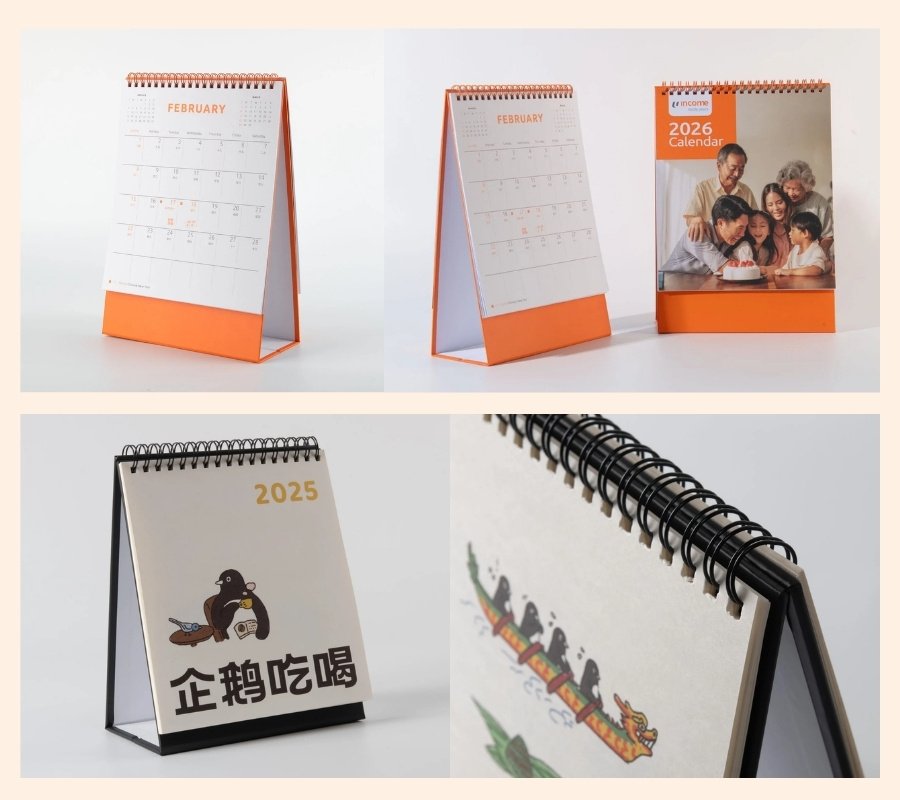
Forest Print offers desk calendars in A5 and DL tent-style formats.
A5: Gives photography, illustrations and branded content more room. This can be useful when visual presentation is an important part of the calendar.
DL: Takes up less desk or counter space and works well when the calendar needs to stay practical without dominating the workspace.
If A5 or DL doesn’t suit your layout, Forest Print can also produce custom calendar formats based on the artwork and intended use. Confirm the dimensions early, especially if packing or distribution is part of the brief.
Size is only one part of making a desk calendar practical. It also needs to remain upright and easy to use throughout the year.
Choosing the Right Desk Calendar Construction
Wire-O binding is commonly used so pages turn cleanly while the calendar stays upright. Folded self-standing formats are also available, and the right choice depends on the quantity and design. It’s worth confirming the construction before artwork is finalised so the layout can accommodate the binding and finished format.
Desk calendars are less effective when recipients don’t have a permanent workstation or when one calendar needs to serve several people. In those situations, a wall format may make better use of the available space.
Wall Calendar Printing: Best for Shared Spaces
Wall calendars work well in workshops, staff rooms, site offices and reception areas, where several people refer to the same calendar. One calendar can therefore serve a whole workplace, household or team rather than a single user.
The larger print area leaves more room for imagery and for bigger date boxes.
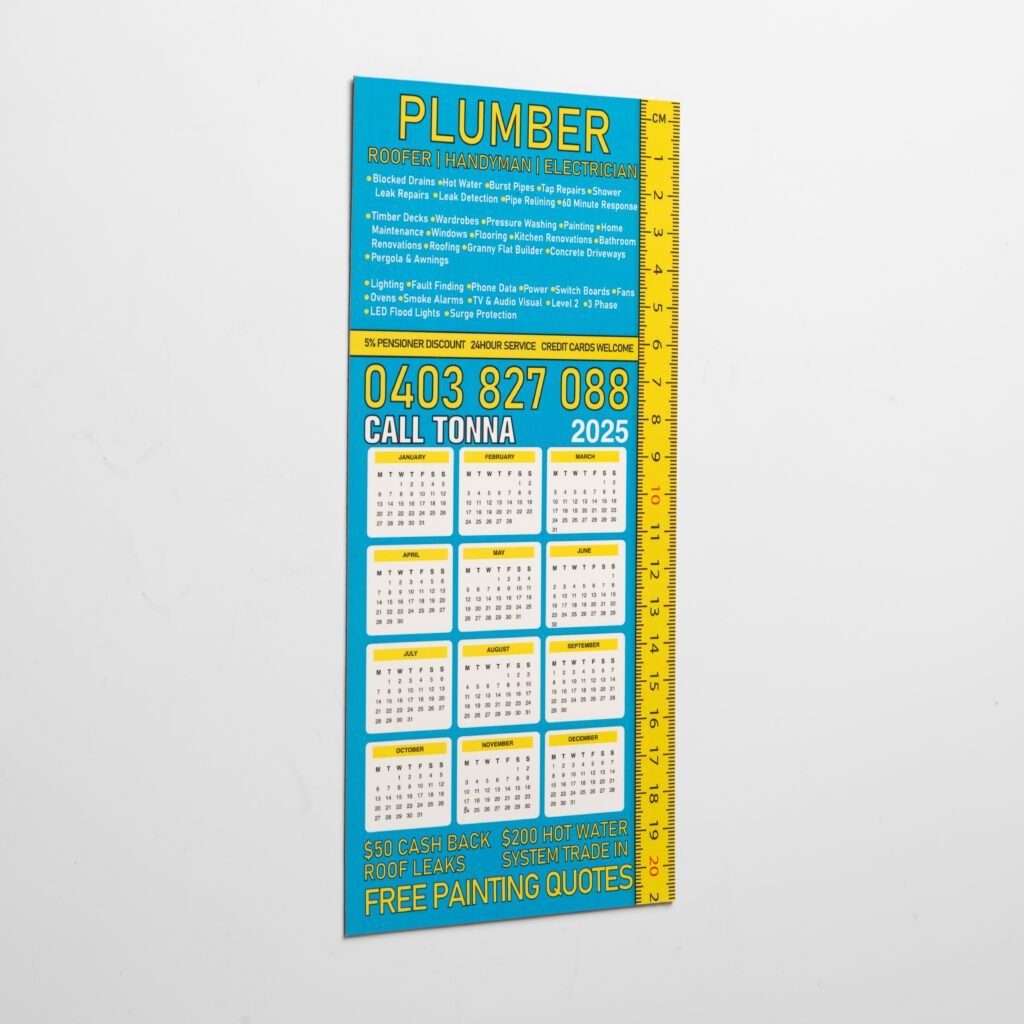
Forest Print’s wall calendar printing includes single and multi-sheet calendars in portrait and landscape formats. The amount of information and artwork you want to include will help determine whether a single or multi-sheet format is more suitable.
Choosing Between Single and Multi-Sheet Wall Calendars
Wall calendars come in two broad configurations. The choice comes down to how much each month needs to carry.
• Single-sheet: The full year on one sheet. Suits businesses that need a clear date reference without separate monthly artwork or large writing areas.
• Multi-sheet: A page per month, with room for imagery, messages and bigger date boxes. Heavier and more paper-intensive, but the better option when the calendar carries visual or promotional content all year.
Multi-sheet calendars are usually Wire-O bound with a header strip, so each month turns over as the year progresses. Page count and finished size determine the most suitable construction.
Multi-sheet formats use more paper, which is where stock choice matters most. FSC®-certified and responsibly sourced stocks are available for both configurations.
Size behaves differently once distribution enters the picture. A large wall calendar earns its place once it is on the wall, but becomes less practical when every copy is mailed individually, and its finished size adds packing and freight costs.
That trade-off is easier to settle once you know what the calendar is for.
Promotional Calendars: Plan Around How They’ll Be Distributed
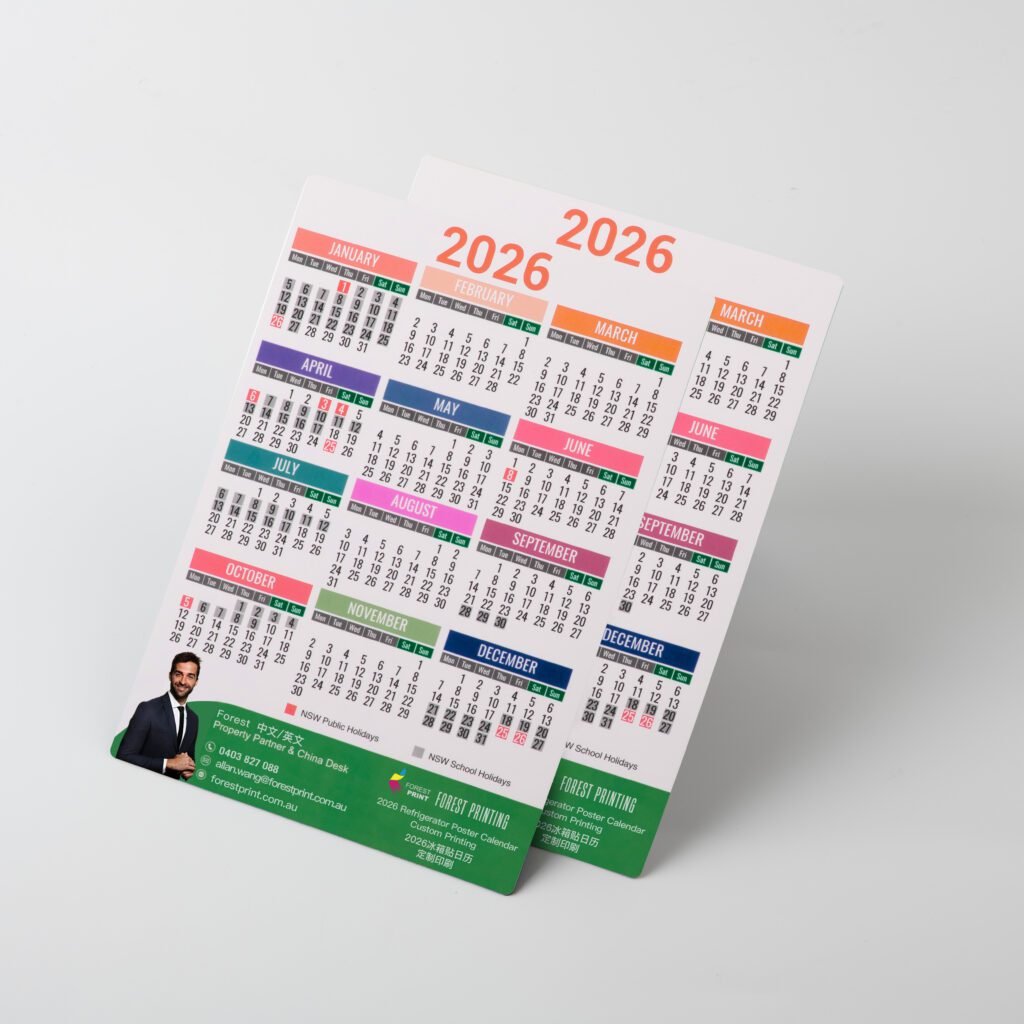
Promotional calendar printing refers to how the calendar is being used rather than a separate calendar format. A promotional calendar might be an A5 desk calendar mailed to individual clients or a wall calendar distributed to households, branches, workshops or trade contacts.
Distribution drives the brief. A calendar mailed to a professional client has a different job from one handed out at a trade show or delivered in cartons to multiple sites. Branding has to stay visible without crowding the usable calendar space, and the size, weight and construction should suit how the calendar reaches the recipient.
Grouping common uses by distribution method makes the format choice easier:
- One-to-one distribution: End-of-year client mail-outs, sales representative visits, corporate gifting and membership packs. Desk calendars suit these, being compact and designed for a single user.
- Bulk or open distribution: Trade shows and industry events, reception counters, customer giveaways, and dealer or franchise networks. Wall calendars work better where several people will see the same copy.
Practicality matters as much as appearance here. A calendar only delivers ongoing exposure if the recipient finds somewhere useful to put it.
Which Calendar Format Should Your Business Choose?
If both formats could work, consider the audience, intended display location and distribution method together.
| Business or campaign | Format to consider first | Why |
| Accountants, lawyers and financial advisers | Desk | Fits naturally into an office-based client’s workspace |
| B2B suppliers targeting individual contacts | Desk | Compact and suited to one-to-one distribution |
| Real estate agencies | Wall | Can remain visible in homes and shared spaces |
| Builders and trade suppliers | Wall | Works well in workshops, sheds, depots and site offices |
| Businesses showcasing photography or visual work | Multi-sheet wall | Provides more room for imagery throughout the year |
| Retail or hospitality giveaways | Desk or wall, planned as promotional | Choose the physical format around how customers will receive and use it |
| Trade shows | Compact desk or promotional format | Easier for attendees to carry with other material |
| Associations and not-for-profits | Depends on distribution | Mail-outs, events and branch distribution create different requirements |
| Multi-location organisations | Wall or promotional | Bulk delivery makes shared calendars practical |
| Simple annual date reference | Single-sheet wall | Keeps the format straightforward |
| Monthly campaigns or changing messages | Multi-sheet desk or wall | Gives you fresh printable space each month |
These recommendations are a starting point, not fixed rules. A real estate agency targeting commercial property managers may find desk calendars more useful, while a business supplying calendars to an entire office may prefer wall calendars.
Once you’ve chosen a format, the next step is working out what to brief your printer on. You don’t need to have every production detail decided upfront.
What to Think About Before You Brief a Printer
Five details will make the initial conversation easier:
1. Format and size
Desk or wall, plus your preferred A5, DL, portrait, landscape or custom dimensions.
2. Quantity
Base this on the number you intend to distribute rather than a round figure. Forest Print handles commercial calendar runs from 500 copies.
3. Paper and binding
Let your printer know whether the calendar needs to prioritise photography, writing space, durability or lower packed weight. They can then recommend suitable stock, GSM, and a binding method. If FSC®-certified or recycled stock is a procurement requirement, raise it when you request a quote, since availability and lead time vary by stock.
4. Artwork
Confirm whether you have finished print-ready artwork or whether the design is still being developed.
5. Distribution and timing
Let the printer know whether the calendars are going to one address, multiple branches, individual customers or an event, along with the required delivery date. Calendar production usually takes around 30 days, with roughly another 30 days for sea freight to Australia, so allow about 60 days from artwork approval. Timelines vary with quantity and specification. Work back from the date you need them in hand and leave room for proofing before that.
These details are particularly important when planning custom calendar printing for business, as they help Forest Print recommend the appropriate specification and prepare a more accurate quote.
Ready to Choose Your Calendar Format?
The right format follows from the recipient and how the calendar reaches them.
If you’re still weighing up between desk calendar printing and custom wall calendar printing, Forest Print can help you work through the practical considerations, from format and paper stock to binding, quantity and distribution. Send the team your artwork or project requirements to discuss the most suitable specification for your 2027 commercial calendar run.